Takeaway
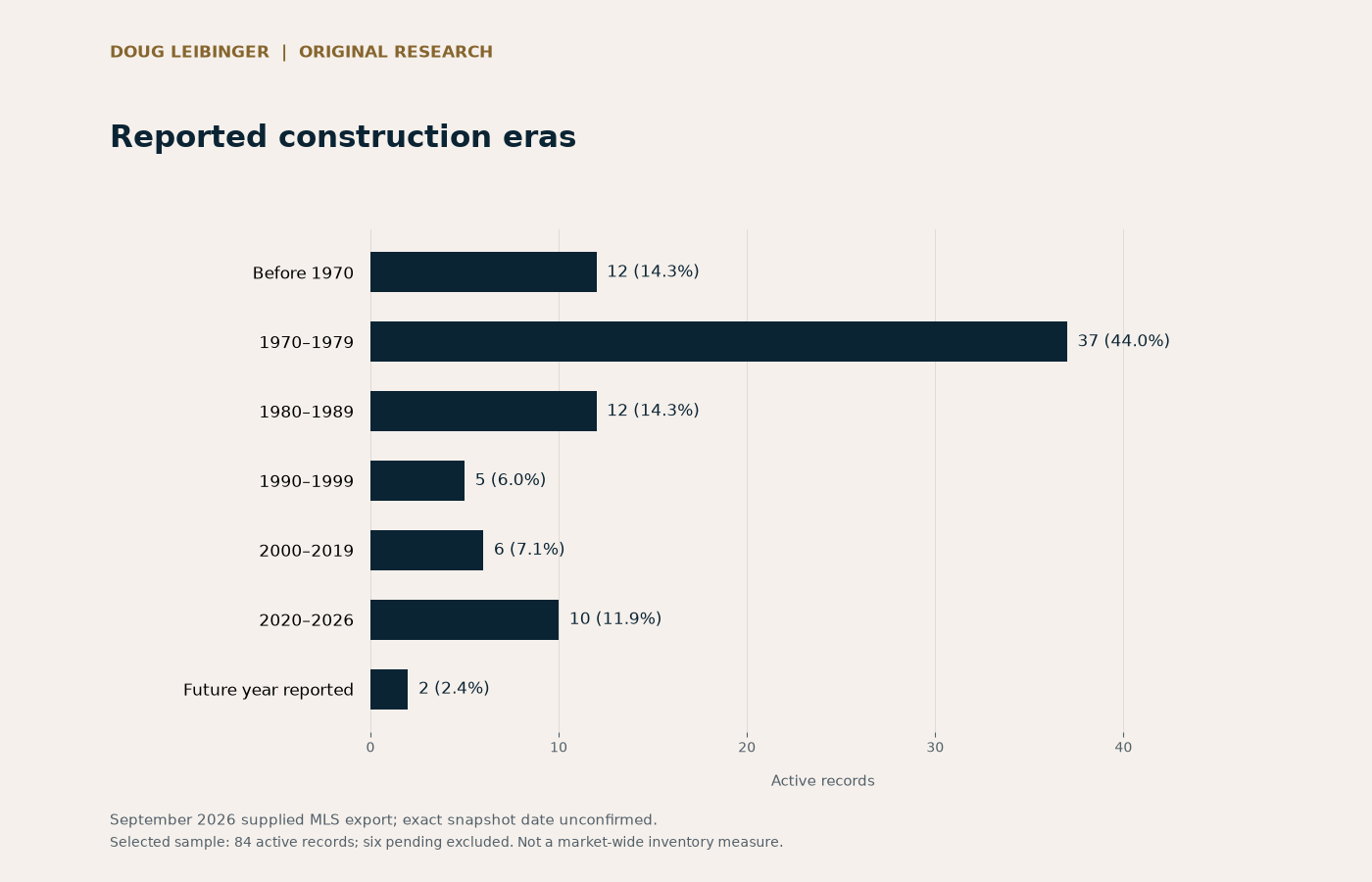
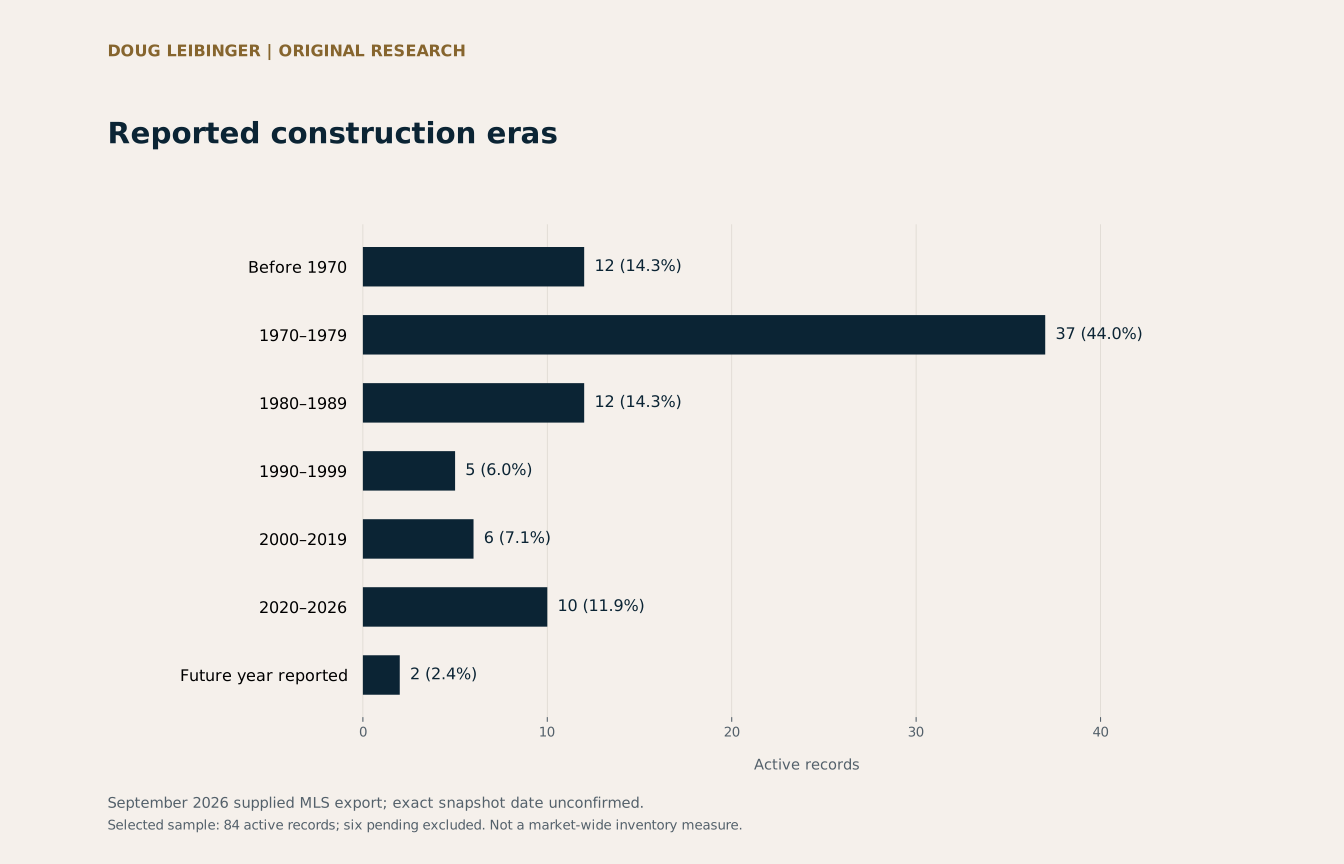
Thirty-seven of 84 active records report a 1970s build year. Ten report 2020–2026 and two report 2027; future-year entries remain separate and unverified.
Geography
Aspen, Snowmass Village and Snowmass (Old Snowmass), Colorado
Population
84 active records selected from a 90-record supplied export; six pending records excluded. Observed active asking prices: $2.05M–$4.995M. Selection criteria were not supplied.
Study sample
84 selected records
Reported construction eras
Unit: Active records
Reported year-built groups
| Reported era | Active records | Share of 84 |
|---|---|---|
| Before 1970 | 12 | 14.3% |
| 1970–1979 | 37 | 44.0% |
| 1980–1989 | 12 | 14.3% |
| 1990–1999 | 5 | 6.0% |
| 2000–2019 | 6 | 7.1% |
| 2020–2026 | 10 | 11.9% |
| Future year reported | 2 | 2.4% |
Two reported 2027 values remain in the future-year category. Year Built is not a verified completion date, renovation history or condition score.
The 1970s form the largest reported era
Thirty-seven of the 84 active records report a year built from 1970 through 1979. Twelve report a year before 1970 and another 12 fall in the 1980s. The era distribution describes the buildings represented by this selection; it is not a census of housing age across Aspen or the valley.
Ten records report a year from 2020 through 2026. Two additional records report 2027 and are placed in a separate future-year category. The export cannot establish whether those values reflect planned completion, an input issue or another reporting convention.
Age and condition are different measurements
Year Built does not identify the extent or quality of subsequent renovations. It also does not verify construction completion, code compliance, energy performance or the remaining life of systems and shared building components.
The study groups reported years without assigning an age-based quality score. A buyer can use the resulting profile to organize document requests and inspections, while retaining the need to verify the history and condition of the specific property.
Methodology
- Source: an MLS export supplied for Doug Leibinger’s research. The analysis uses 84 rows with Status=A and excludes six rows with Status=P; there are no duplicate listing IDs.
- Group reported Year Built values into the displayed eras. Values after 2026 remain a separate future-year category and do not support a completed-building age claim.
- Medians use the middle ordered value, or the average of the two middle values. Counts may be shown for small categories, but no price, size or fee statistic is published for a group under five. Percentages may not sum to exactly 100% because of rounding.
Limitations
- This is a selected sample, not a market-wide inventory count or a random sample. No sale prices, appreciation, absorption, causal premiums or forecast are inferred.
- The filename says September 22, but 13 records have later modification dates. The research does not claim a confirmed September 22 snapshot; publication on September 28 is a separate date.
- Listing fields are reported information. Availability, property rights, condition, costs and individual source values have not been independently verified for this research.
Data and attribution
Original analysis published by Doug Leibinger from a user-supplied MLS export. Listing fields were reported by participating brokers; the private source file is not redistributed.
Download aggregate CSVDownload chart (PNG)Download chart (SVG)
Companion article
Thirty-seven active records report a 1970s build year. Explore the selected Aspen-area sample and use building age to guide questions, not to infer condition.
Read Aspen-Area Home Ages: What Construction Year Tells You