Takeaway
Two-bedroom listings make up 45 of the 84 active records. Their median reported living area is 1,040 sq ft; bedroom count alone does not describe layout or value.
Geography
Aspen, Snowmass Village and Snowmass (Old Snowmass), Colorado
Population
84 active records selected from a 90-record supplied export; six pending records excluded. Observed active asking prices: $2.05M–$4.995M. Selection criteria were not supplied.
Study sample
84 selected records
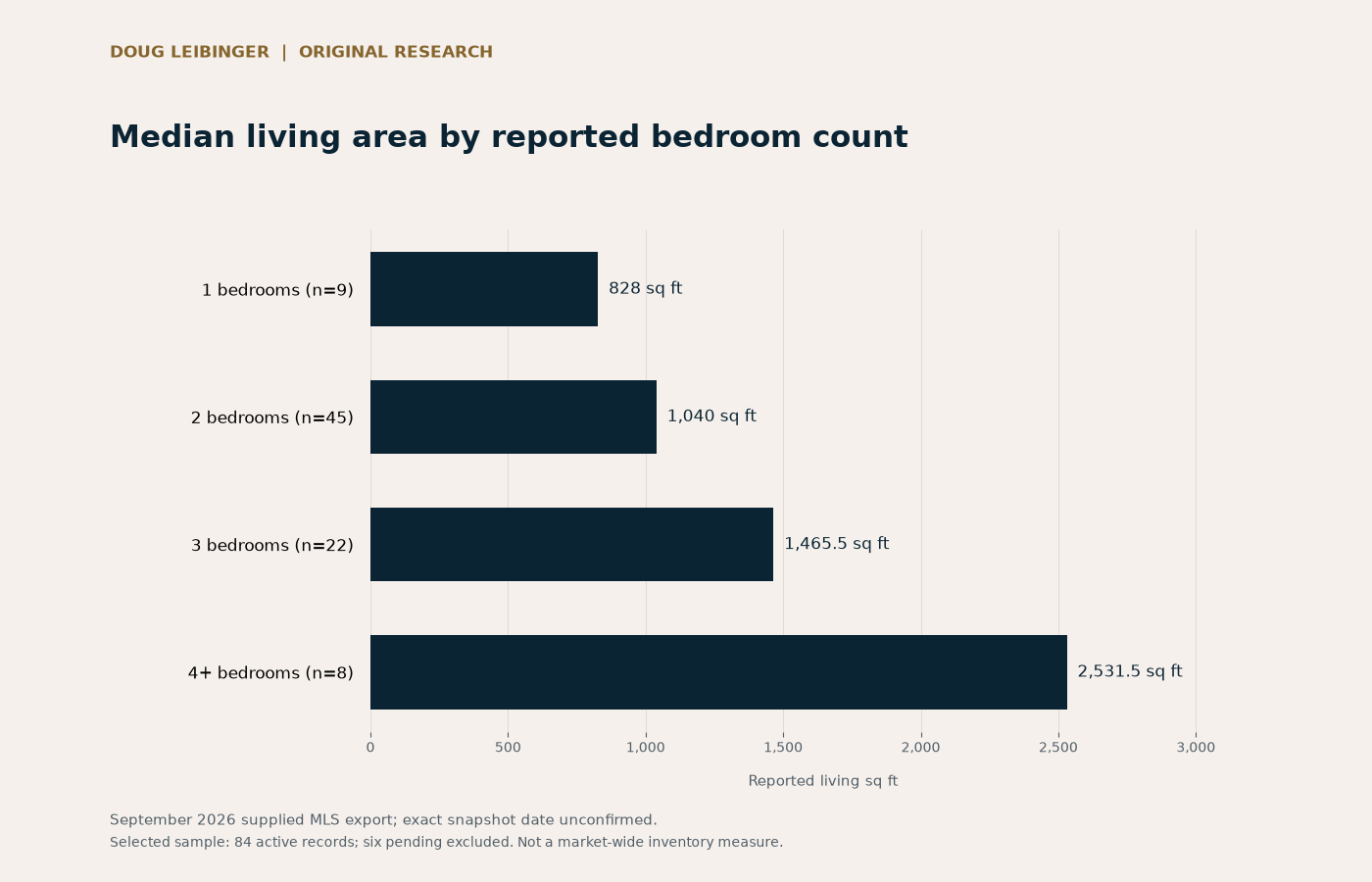
Median living area by reported bedroom count
Unit: Reported living sq ft
Bedroom groups with reported living area
| Reported bedrooms | Records | Median ask | Median living sq ft |
|---|---|---|---|
| 1 | 9 | $2,395,000 | 828 |
| 2 | 45 | $3,095,000 | 1,040 |
| 3 | 22 | $3,372,500 | 1,465.5 |
| 4+ | 8 | $3,473,500 | 2,531.5 |
Four- and five-bedroom records are combined into a group of eight. No marginal bedroom-value effect is estimated.
Bedroom counts describe layout capacity imperfectly
Two-bedroom listings account for 45 of the 84 active records, making that the largest bedroom category in the supplied selection. There are nine one-bedroom records and 22 three-bedroom records. Four- and five-bedroom records are combined into a group of eight for summary statistics.
A bedroom count is a reported characteristic, not a measure of room dimensions, privacy, legal sleeping capacity or the suitability of a particular floor plan. The study pairs bedroom categories with reported living area and asking price to show why count alone is an incomplete description.
More bedrooms do not create a controlled price ladder
The asking-price range and geography of this sample were selected before the analysis. Bedroom groups can contain different locations and property forms. A group with more bedrooms can therefore have a lower median asking price without establishing that an additional bedroom reduces value.
The practical use of the table is to identify which configurations appear in this file and what further comparisons they require. It cannot estimate the marginal value of a bedroom. Buyers should inspect floor plans; sellers should compare genuinely similar properties before drawing pricing conclusions.
Methodology
- Source: an MLS export supplied for Doug Leibinger’s research. The analysis uses 84 rows with Status=A and excludes six rows with Status=P; there are no duplicate listing IDs.
- Group reported Bedrooms as 1, 2, 3 and 4+. All 84 records have usable price and living-area values; four- and five-bedroom records are combined for statistics.
- Medians use the middle ordered value, or the average of the two middle values. Counts may be shown for small categories, but no price, size or fee statistic is published for a group under five. Percentages may not sum to exactly 100% because of rounding.
Limitations
- This is a selected sample, not a market-wide inventory count or a random sample. No sale prices, appreciation, absorption, causal premiums or forecast are inferred.
- The filename says September 22, but 13 records have later modification dates. The research does not claim a confirmed September 22 snapshot; publication on September 28 is a separate date.
- Listing fields are reported information. Availability, property rights, condition, costs and individual source values have not been independently verified for this research.
Data and attribution
Original analysis published by Doug Leibinger from a user-supplied MLS export. Listing fields were reported by participating brokers; the private source file is not redistributed.
Download aggregate CSVDownload chart (PNG)Download chart (SVG)
Companion article
Original research on bedroom counts and reported living area helps Aspen-area buyers compare layouts without assuming more bedrooms always mean a higher price.
Read Choosing Bedrooms and Usable Space in an Aspen-Area Home